I still vividly remember the days when E3 felt like Christmas morning, albeit a Christmas where Santa ran on an RTX 9090 Ti and handed out release dates instead of socks. But as I sit here in 2026, scrolling through yet another lineup of livestreamed keynotes, I realize that event has mutated into something closer to a yearly wake. It’s as if the ESA keeps trying to jump-start a corpse with a pair of AA batteries and a hopeful prayer. The buzz, the sweaty crowds, the deafening booth speakers—all replaced by a glowing web portal that somehow feels less interactive than a PowerPoint presentation from 1998.
At its core, E3 has always been about spectacle, but the shift away from physical showcases has hollowed out its soul. Major publishers realized they could save millions by hosting their own online events, and honestly, who can blame them? Watching E3 try to stay relevant today is like watching a floppy disk try to seduce a cloud server. Sony famously bailed years ago, and many others followed, viewing the convention more as a luxury yacht party they were no longer obliged to attend. The exodus was only accelerated by the pandemic, but the habit stuck. Why pay for a booth when a 30-minute YouTube premiere can generate the same hype without the risk of someone’s demo crashing in front of a live audience?
Then there’s the content itself, which in recent years has often lacked the substance to justify a marathon viewing session. I’ll never forget the Gearbox showcase back in 2022—a masterclass in narrative emptiness that still haunts my dreams. The company devoted most of its airtime to Randy Pitchford ambling around the Borderlands movie set like a man who had lost his keys in a fog machine. No new trailers, no jaw-dropping announcements, just silhouettes and awkward banter that felt like eavesdropping on a rehearsal nobody greenlit. It was the video game equivalent of attending a concert where the band spends 45 minutes tuning their guitars and then walks off stage.
Equally baffling was Take-Two Interactive’s decision to use their E3 slot for a diversity panel—a noble topic, but about as appropriate for the main stage as a lecture on quantum physics at a monster truck rally. There were zero game trailers, zero teases, just 45 minutes of well-intentioned discussion that left viewers scratching their heads. It was a painful lesson in mismanaged expectations: you don’t invite people to a steakhouse and serve them a PowerPoint on ethical farming without at least offering a bread roll.
Of course, these train wrecks are just symptoms of a broader curation failure. The ESA’s role is to shape the week into a coherent journey, not a patchwork of disconnected monologues. Watching E3 unfold these days is akin to trying to drink soup with a colander—all the flavorful bits slip through the holes, leaving you with a bowl of tepid confusion. Developers need clear guidelines, and the audience needs a reason to stay glued to their screens. Filler content, replayed trailers, and cringe-worthy Zoom calls don’t qualify.
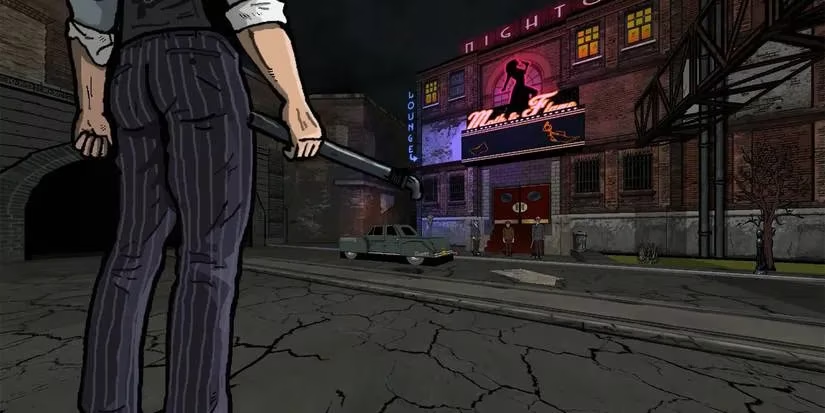
One area that especially tugs at my heartstrings is the plight of indie developers. In the old days, the E3 show floor was a bustling bazaar where a tiny team could carve out fame through sheer enthusiasm and a memorable demo. Now those same creators are forced to compete in a digital ocean where visibility is a cruel lottery. The 20-minute indie showcase still exists, and it has introduced gems like Fallen Aces, but that’s like handing out a single appetizer to a starving crowd. A dedicated digital “indie portal” on the ESA’s website could replicate the serendipitous magic of the physical floor—imagine a virtual arcade where pixel art knights rub shoulders with first-person noir detectives. But instead, we get a brief highlight reel that feels more like an afterthought than a commitment.
By mid-2026, the ESA has attempted to patch these issues with a hybrid model—some physical events, some online panels—but the scars remain. The show still struggles to balance AAA spectacle with genuine discovery. Without a serious reinvention, E3 will continue to drift like an aging satellite, occasionally beaming down signals of nostalgia but mostly just cluttering the atmosphere. We don’t need a resurrection of the sweaty, overpriced extravaganza; we just need a curated, meaningful celebration of gaming that respects our time and our intelligence. Until then, I’ll keep my expectations low and my snacks ready, because sometimes the best part of E3 is the chat room chaos when another publisher wanders into a metaphorical abyss.
Maybe one day E3 will recapture that old magic, but for now, it’s a dusty trophy case filled with memories of louder, messier, and infinitely more thrilling Junes.