The gaming world was stunned in 2021 when Hazelight Studios' It Takes Two swept major awards, including Game of the Year, proving that a split‑screen only cooperative adventure could capture the hearts of millions. Now, in 2026, the surprise hit is making its way to Hollywood as an Amazon Studios feature, joining the ever‑growing list of video game adaptations. The project has generated both excitement and skepticism, because translating a purely interactive, co‑dependent journey into a passive movie experience might strip away the very soul that made the game unforgettable.
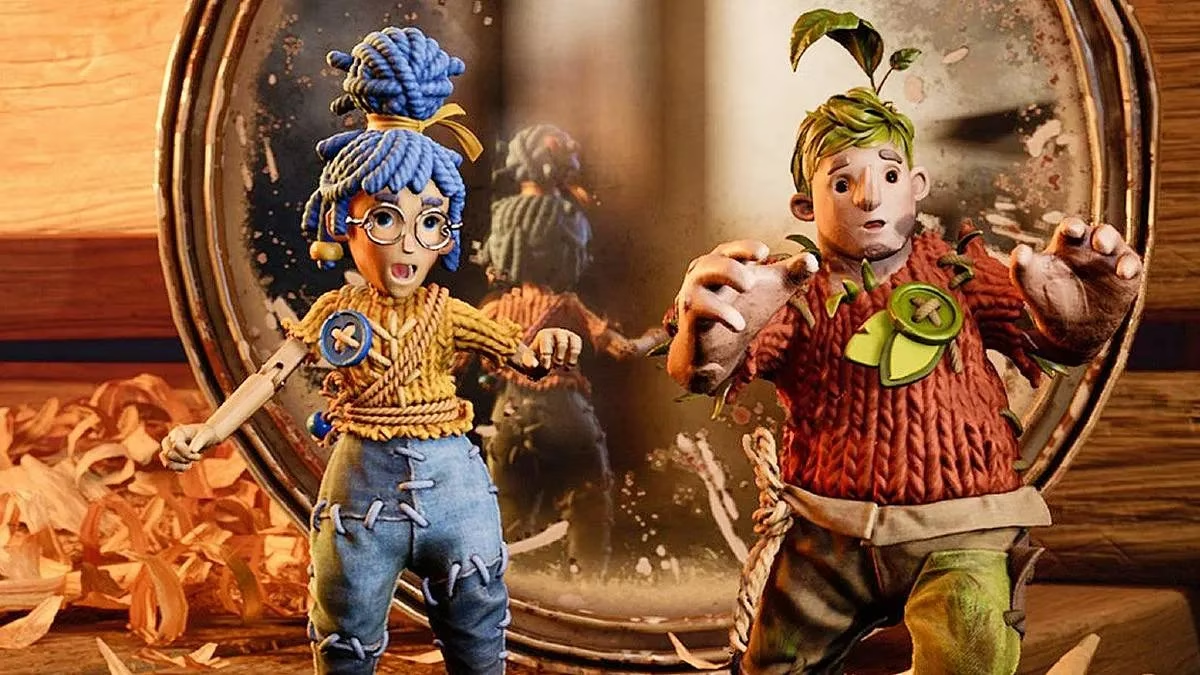
The original title is a phenomenon unlike anything in modern gaming. From start to finish, It Takes Two demands two players, each assuming the role of the bickering couple May and Cody. There is no single‑player mode, no AI companion to carry the weight; every puzzle, every platforming sequence, every boss fight is designed around absolute partnership. The iconic split‑screen presentation is not just a technical choice – it is a constant reminder that both perspectives matter equally, and that progress depends utterly on communication. As miniature clay figures, metallic robots, or garden explorers, players must align their actions to repair a broken marriage, one fantastical level at a time. That collaborative tension turned the game into a worldwide sensation and cemented the studio’s reputation.
Yet, it is precisely this deeply embedded interactive layer that raises red flags for the film version. It Takes Two is a masterpiece not only because of its whimsical art style or heartfelt story, but because players physically inhabit the struggle of May and Cody. Early on, they fumble through simple tasks, frequently failing – and in those failures, they mirror the protagonists’ frustration. As trust grows, so does the synergy. Beating a ridiculous, emotionally wounded boss like the Moon Baboon with a well‑executed laser shot is triumphant not just on screen, but in the living room, where two people high‑five, laugh, or blame each other for near misses. A movie can show that victory, but it can never recreate the adrenaline of perfectly timing a move with a friend.
The humor of the game, too, is inherently participatory. Many of the funniest moments spring from accidents – a missed jump that sends one player into a fan blade, a deliberate betrayal during a safe platforming section, or the chaotic aftermath of a misunderstood instruction. These personal, unscripted gags become inside jokes between partners, and they form the emotional core of the playthrough. A screenwriter can craft witty dialogue and slapstick sequences, but they cannot replicate an entire dimension of shared discovery. This is the fundamental gap between the medium of video games and that of cinema, a gap that widens when a title is so uniquely married to its mechanics.
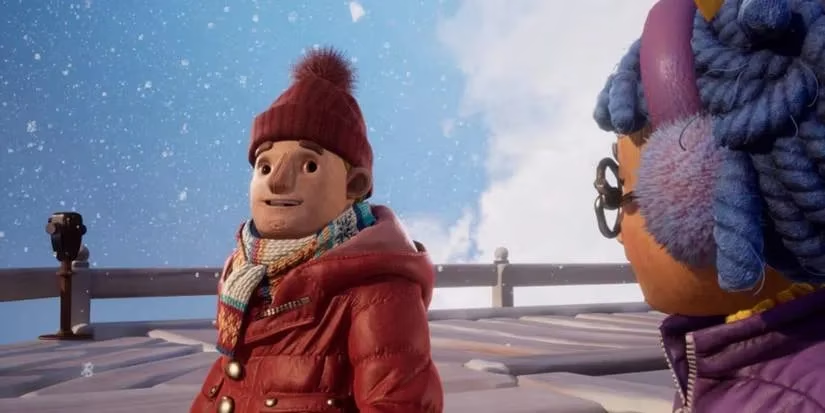
Pat Casey and Josh Miller, the duo behind the successful Sonic the Hedgehog films, are tasked with the screenplay. Their track record offers a sliver of hope; they understand how to translate gaming icons for a broader audience without alienating core fans. Still, Sonic is an action‑platformer built around a solo protagonist, a far simpler narrative vessel. It Takes Two requires viewers to care deeply about two characters and their co‑dependent growth, all without the glue of interactive teamwork. The emotional beats of the story – rediscovering love, reconnecting with a daughter, overcoming personal flaws – can certainly shine on a big screen, provided the adaptation finds a way to visually externalize the internal cooperation that players once felt physically. But even if the film succeeds as a family dramedy, something essential will be lost: the unique sensation of being an active participant rather than a spectator.
Looking at the broader trend of video game movies in 2026, it is clear that Hollywood sees an enormous appetite for these properties. It Takes Two entering the cinematic space could introduce Hazelight’s philosophies to millions who never picked up a controller, which is undeniably a win for the studio. More mainstream exposure might even fuel a wave of new players who buy the game to experience the original magic first‑hand. Nevertheless, the adaptation arrives with a quiet unease among fans. No matter how beautifully shot or emotionally acted the movie might be, it will ultimately be a separate artwork, one that can only point toward the interactive miracle it was born from.
In the end, the It Takes Two film will be judged on its own merits. It may charm audiences, win awards, and become another feather in Amazon’s cap. But as a testament to the unbridgeable divide between media, it also serves as a reminder: some experiences cannot be translated – they must be lived, controller in hand, side by side.