Even as we step into 2026, few games still hum with the same electric charm as It Takes Two. The co‑op masterpiece by Hazelight Studios made its long‑awaited landing on the Nintendo Switch some time ago, and the buzz around it refuses to quiet down. Josef Fares, the game’s writer and director, practically vibrates with excitement when he talks about more players finally getting their hands on his labour of love. “It’s a love letter to collaboration,” he says, and honestly, that is putting it mildly. From the very first button press, the game winks at you—you’re in this together, pal, so don’t even think about going solo.
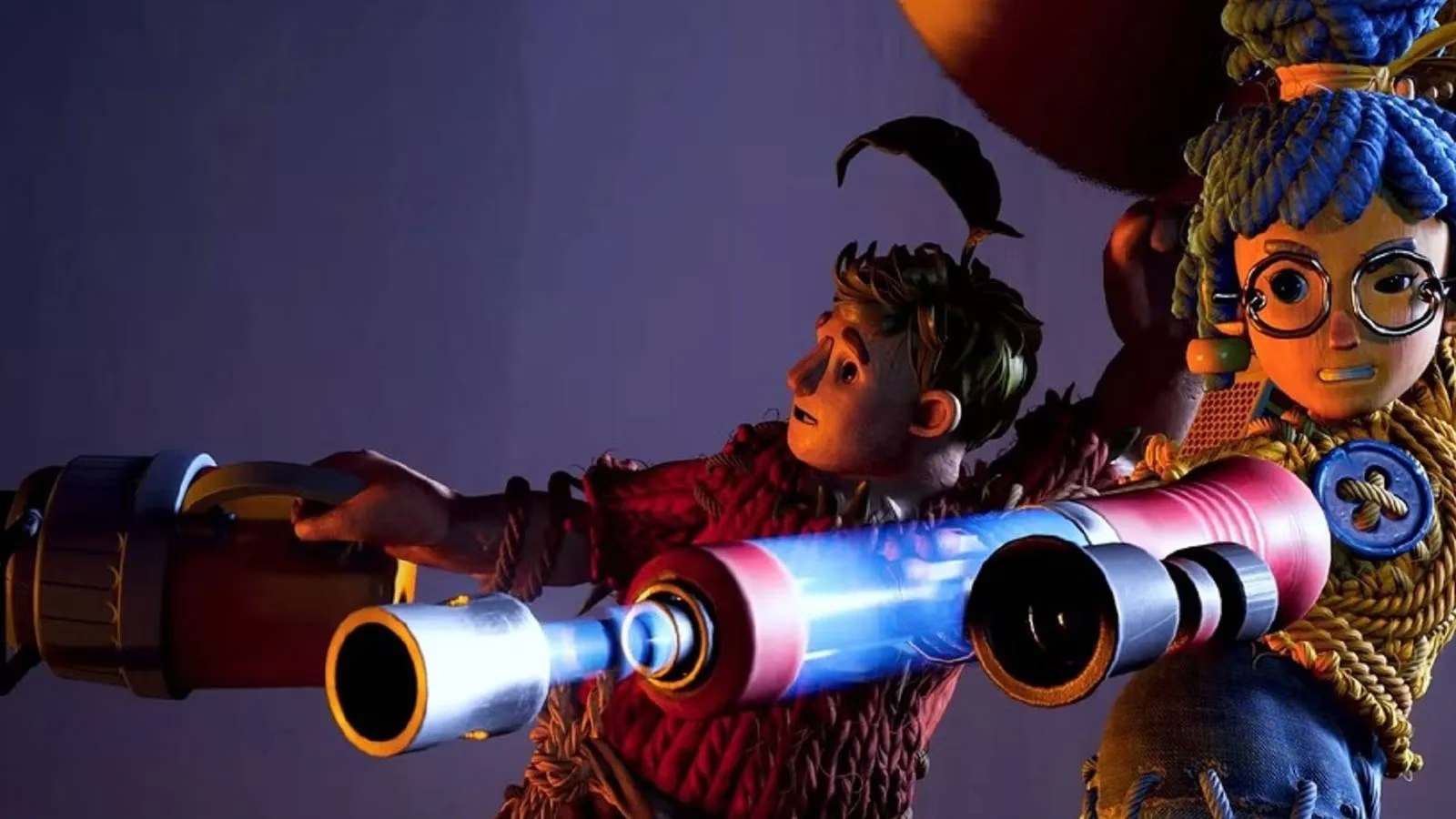
But peel back the colourful set‑pieces and the madcap mini‑games, and you find something far more delicate: a story that breathes only when two people share it. Fares and the porting wizards at Turn Me Up recently sat down to discuss what it means to break rules in game design, and how pushing the envelope on content can reshape the way we think about narrative itself.
The complex heartbeat of a story for two
While It Takes Two was a groundbreaking entry in story‑driven multiplayer, Fares insists we are merely scratching the surface of what the medium can do. Telling a tale that two players experience simultaneously is like trying to conduct an orchestra while both musicians are also humming their own tunes. He explains the delicate balancing act:
“When we write the story, we try to balance the pacing because we know that players talk to each other. They don’t have the same focus that you do when you’re playing alone. So there’s already a lot of complexity in telling the story for two players.”
Think about that for a second. In a single‑player game, the narrative can grab you by the collar and whisper in your ear. But in co‑op, your partner might be cracking a joke just as a heartfelt confession lands on screen—or worse, you might both be so busy solving a puzzle that the emotional beat slips by unregistered. Fares points out that past a certain number of players, a party stops chasing the scripted story and starts making its own narrative. That spontaneous player‑driven chaos can be beautiful, of course, but it also threatens to derail the carefully crafted moments that make narrative games matter.
Adding a third or fourth player? That is where the math gets scary. Pacing, communication, and character motivations all become interlocked chains, and each extra link multiplies the balancing act. For now, Fares seems content to perfect the dance for two—and honestly, the game’s millions of fans would likely beg him not to mess with a winning formula.
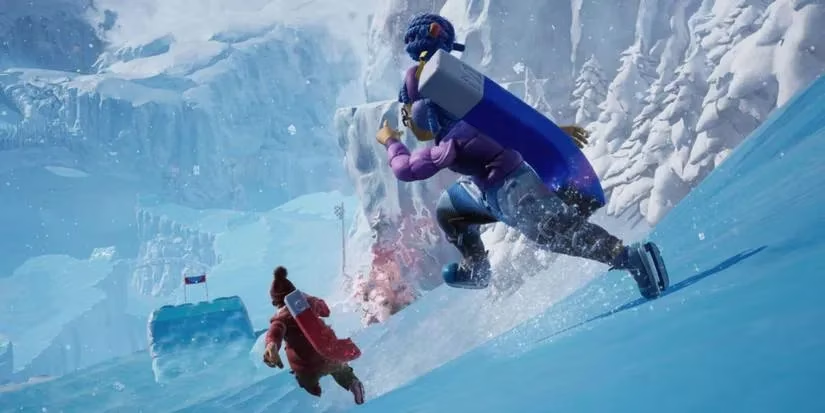
Movies, games, and the myth of the auteur
Fares often jokes that when he wants to take a vacation, he will return to making movies. Having straddled both worlds, he sees a chasm that outsiders rarely appreciate. In film, you can swap out a crew member and often keep rolling; if a scene doesn’t work, you reshoot it. But in game development, every person’s contribution is a thread in a tapestry. Yank one, and the entire picture distorts.
“Collaboration in movies is still important, but with games, it needs to be even tighter. Everybody needs to be on the same wavelength. It’s almost as if everybody’s contribution is more important. In movies, you can easily change out people, but in games, everybody needs to be on the same track.”
Just imagine changing a single level in It Takes Two. That one tweak might break a dozen interconnected puzzles, shift the emotional arc of a character, or force the audio team to re‑record hours of dialogue. The ripple effect would be staggering. A game is a living organism, not a sequence of scenes you can re‑edit in post. This is why Fares urges his team to treat every decision as monumental—without, however, slipping into the prison of groupthink.
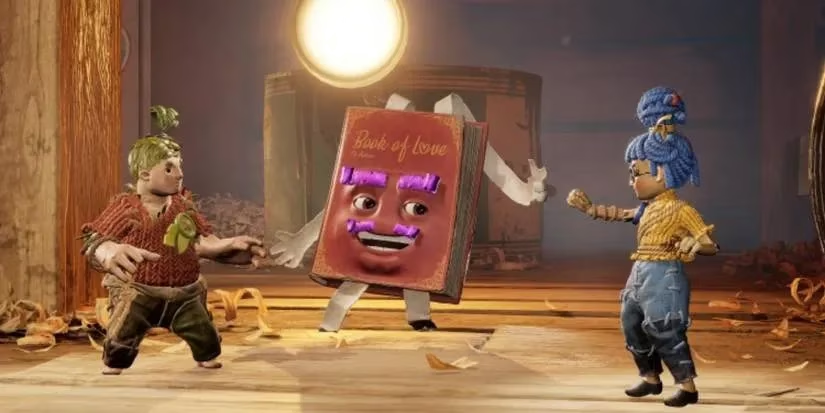
“We don’t know how to make games”—and that’s the point
If there is one thing that makes Josef Fares’s eyes glaze over, it’s someone walking into his office armed with hard‑and‑fast rules on how games should be built. He loses interest immediately. His philosophy is disarmingly simple, and it has become something of a mantra at Hazelight: we don’t know how to make games. Not because the team lacks talent—quite the opposite—but because clinging to so‑called best practices is a fast track to mediocrity.
To him, anyone who claims to have all the answers is usually trapped in outdated design principles. True collaboration, the kind that births games like It Takes Two, thrives on open‑mindedness. It’s about bringing wild, out‑of‑the‑box ideas to the table and then weaving them into a cohesive whole. The moment a designer hears “this is how we’ve always done it,” they ought to hear alarm bells. The industry moves too fast, and players’ expectations evolve even faster. What felt revolutionary in 2021 could feel like a museum piece by 2026 unless you keep pushing the envelope.
A stress test for relationships (not just the romantic ones)
It did not take long for the internet to crown It Takes Two as the ultimate game for couples. And sure, the central story of a bickering husband and wife who must rediscover communication before their divorce is finalised has romantic overtones thick enough to make a Hallmark writer blush. But Fares insists Hazelight never built the game with couples in mind specifically. Instead, it simply became a mirror—a way to test how any two people interact when they absolutely must rely on one another.
Play it with your best friend, and you might discover a new rhythm of unspoken teamwork. Play it with your kid, and you will learn patience you never knew you had. Play it with a spouse, and, well… let’s just say a few tricky boss fights can reveal more about a partnership than months of couples’ therapy. The game becomes a stress test, a bonding ritual, and a personality assessment all rolled into one colourful package. Talk about a modern love story, right?
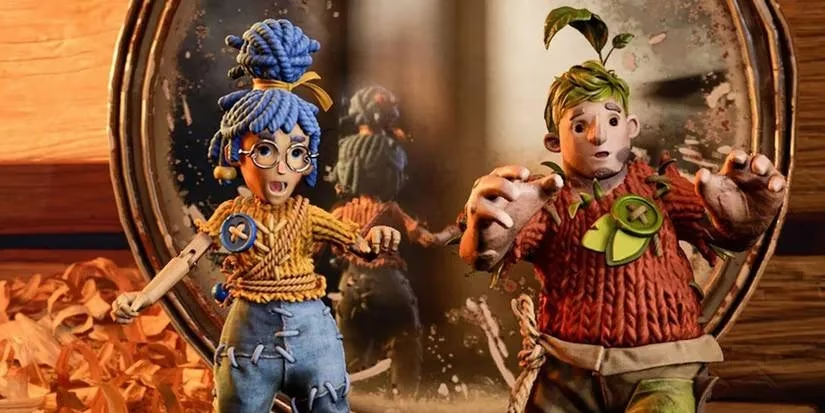
This all circles back to Fares’s core belief: storytelling is an inherently social act. Long before movies or books, people huddled around fires and spun tales in groups, reacting to each other’s gasps and laughter. Narrative co‑operative games like It Takes Two essentially reintroduce that collaborative element that gets lost when we passively consume a story alone. When you and your partner high‑five after solving a puzzle or exchange a knowing glance during a cutscene, you are not just playing a game—you are co‑authoring a memory.
The switch that keeps on giving
Even now, years after its original launch, It Takes Two continues to find new homes. The Nintendo Switch version brought portability to a game that turns aeroplane rows and living‑room sofas into tiny adventure zones. It is available on practically every modern platform—PC, PlayStation 4, PlayStation 5, Xbox One, Xbox Series X|S, and Switch—which means almost no one has an excuse to miss out. The game remains a shining proof that collaboration, both in its creation and its consumption, can produce something genuinely timeless.
And as Josef Fares teases his next project, one thing feels certain: whatever comes next will probably shatter a few more rules, demand we talk to each other like humans, and remind us that even today, we still do not fully know how to make games—and that is exactly why the future looks so bright.