Ah, video games in 2026 – they're not just about shooting aliens or scoring goals anymore, are they? I remember when games were simpler, but now they're like interactive movies with more emotional depth than my last therapy session. While father-son duos seem to get all the spotlight (looking at you, Kratos and Atreus), I've always been fascinated by the complex, messy, and sometimes beautiful relationships between mothers and daughters in gaming. Let me take you on a journey through some of the most memorable ones that still resonate with players today, because apparently, we all love digital family drama more than reality TV!
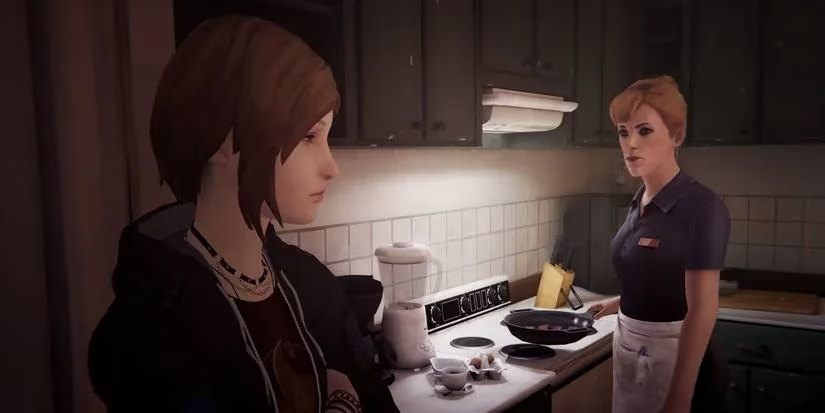
First up, let's talk about Life is Strange – a game that made me cry more than my last breakup. Chloe Price and her mother Joyce have what I'd call a 'complicated' relationship, which is gaming code for 'messy family drama with time travel.' Joyce carries the guilt of her husband's death after asking him to run an errand, while Chloe... well, Chloe is a walking emotional hurricane with blue hair. Their interactions are so painfully real – the unspoken blame, the awkward dinners, the way they love each other but can't quite bridge the gap. Playing as Max and watching their dynamic unfold made me want to call my own mom and apologize for my teenage years. The game's time manipulation mechanics perfectly mirror how families often wish they could redo painful moments – if only real life had a rewind button! 😅
Now, for something completely different: Shadwen. This stealth game presents one of gaming's most unique mother-daughter dynamics – it's literally shaped by your murderous tendencies! Shadwen is an assassin on the run with her daughter Lily, and here's the kicker: if you kill too many guards in front of the kid, you permanently damage their relationship. Talk about parenting pressure! I found myself creeping around like a ninja on tiptoes, not because I feared detection, but because I didn't want to traumatize a virtual child. The game turns every stealth decision into a parenting test – do you take the easy kill, or spend ten minutes setting up an elaborate distraction to preserve your daughter's innocence? It's like a dark twist on those parenting simulators, except with more daggers and fewer diaper changes.

Returnal takes mother-daughter trauma to cosmic levels – literally. Selene's relationship with her mother Theia is the emotional core of this punishing roguelike. Theia was an astronaut who neglected Selene, then became bitter after an accident ended her career. This generational trauma is so intense it loops through time and space! What hits hardest is how Selene, despite experiencing this neglect, ends up repeating the cycle with her own son. The game's endless cycles of death and rebirth mirror how family patterns repeat across generations. Each run through Atropos reveals another fragment of their fractured relationship, making me wonder: are we fighting aliens, or our own inherited baggage? The answer, apparently, is both!
Let's lighten the mood with some fantasy drama! The Witcher 3 shows us Yennefer and Ciri's relationship in its fully-formed glory, but the books (and later adaptations) reveal it wasn't always sunshine and unicorns. When they first met, Ciri was basically a magical teenager giving side-eye to her new 'mom' – jealous of Yennefer's looks and resistant to her teaching. Their journey from reluctant mentor-student to genuine mother-daughter bond is one of gaming's great slow-burn relationships. By the time of the games, their reunion is so emotionally charged it makes all the monster hunting worth it. Their dynamic proves that family isn't always about blood – sometimes it's about surviving magical trials and saving the world together!
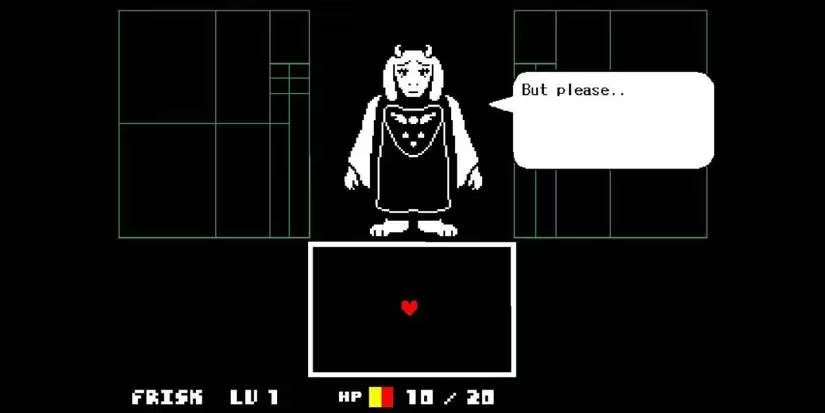
Speaking of found family, Undertale gives us Toriel – the goat mom we all wish we had. She's not Frisk's biological mother, but her protective, pie-baking, fireball-throwing care feels more genuine than many biological relationships in gaming. That first playthrough moment when players realize they don't have to fight her? Pure gaming magic. But here's the dark twist: if you do choose violence, her emotional dialogue and Flowey's later reminders of your actions create one of gaming's most effective guilt trips. Toriel represents unconditional maternal love in a world that often rewards violence, making her a standout in gaming's maternal hall of fame. Plus, she bakes a mean snail pie – though I'll take her word on that taste! 🐌
Finally, let's talk about It Takes Two – a game that made co-op couples therapy fun. While primarily about repairing a marriage, the relationship between May and her daughter Rose provides crucial emotional stakes. That moment when they decapitate Rose's favorite doll? Oof, that hit harder than any boss battle. It's a brutal reminder of how parental conflicts can traumatize children, even in whimsical doll form. What I appreciate is how the game doesn't shy away from showing these parents as flawed, selfish people who need to grow up (literally and figuratively). Their journey toward becoming better parents for Rose gives the entire adventure its heart – and makes all the talking tools and frog kings make emotional sense.
So there you have it – gaming's mother-daughter relationships in 2026 are more diverse and emotionally complex than ever. They range from:
-
Trauma and repetition (Returnal)
-
Guilt and reconciliation (Life is Strange)
-
Found family (Undertale, The Witcher)
-
Parental growth (It Takes Two)
-
Moral parenting tests (Shadwen)
What fascinates me is how these digital relationships often feel more nuanced than their real-world media counterparts. Games let us experience these bonds through interaction rather than just observation – we shape them, suffer their consequences, and sometimes repair them. As gaming continues to mature (both as a medium and for us aging players), I hope we see even more of these complex maternal stories. Because let's face it – sometimes saving the world is easier than navigating family dinner! 🎮👩👧