The Game Awards 2021 shortlist offered a familiar kind of spectacle. There were big-budget heavyweights like Arkane Studios’ Deathloop, Nintendo and MercurySteam’s Metroid Dread, Insomniac’s Ratchet & Clank: Rift Apart, Capcom’s Resident Evil Village, and Double Fine’s Psychonauts 2. Yet the most intriguing nominee was not a sweeping open-world epic or a lone hero’s journey. It was Hazelight Studios’ It Takes Two, an asymmetrical co-op game about a married couple trapped inside handmade dolls.
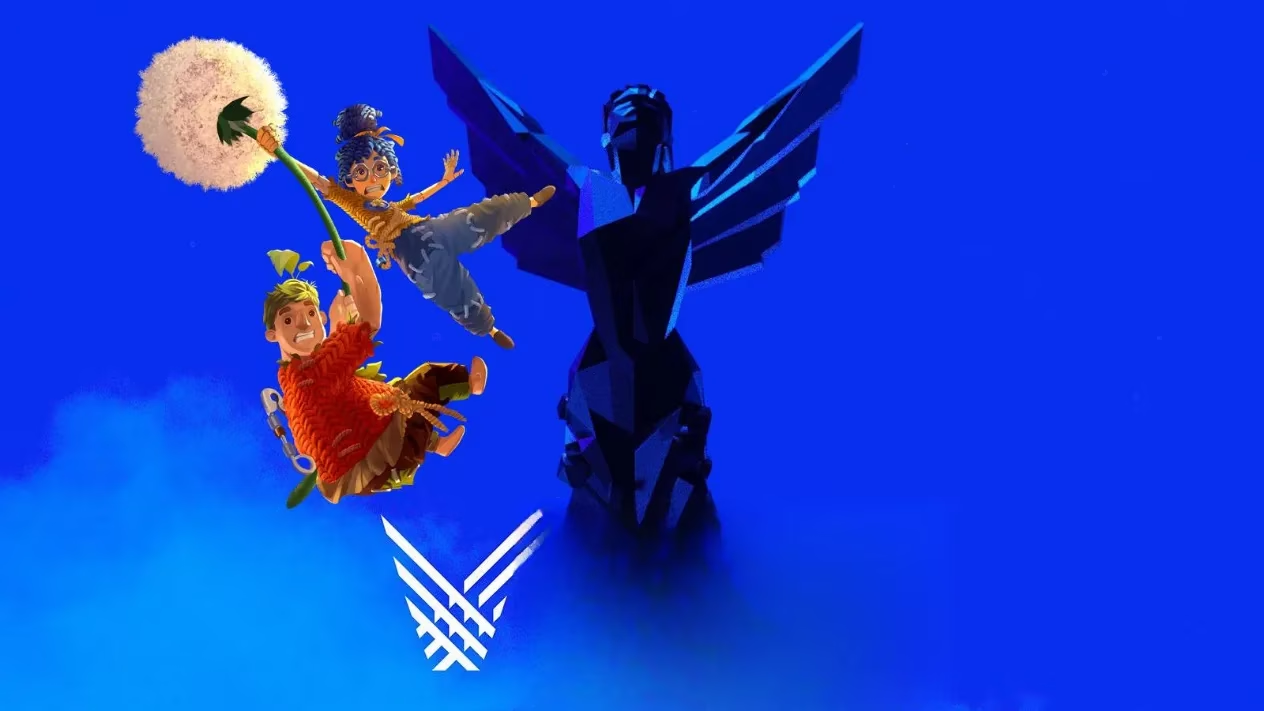
Looking back from 2026, the nomination still feels prescient. At a time when many conversations treated prestige gaming as synonymous with solo cinematic adventures, It Takes Two argued that partnership could be just as emotionally rich, mechanically inventive, and culturally relevant.
A Marriage Put Back Together Through Play
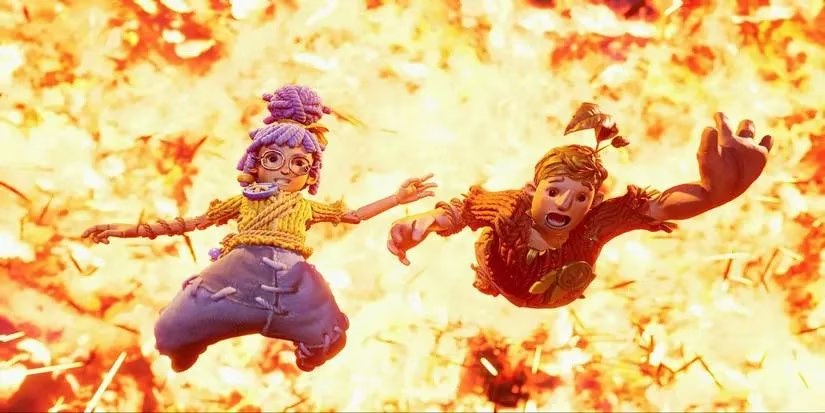
The story follows Cody and May, a couple on the brink of divorce whose strained relationship weighs heavily on their daughter, Rose. Through a burst of accidental magic, Rose traps her parents’ spirits inside two dolls. To return to their bodies, Cody and May must navigate their own home, guided—sometimes helpfully, sometimes irritatingly—by Dr. Hakim, an anthropomorphic relationship book who claims to be an expert on love.
What starts as a goofy premise becomes something much warmer. The house itself turns into an oversized, fantastical playground built from memories, hobbies, and emotional wounds. Every level tells players something about who Cody and May used to be and why they drifted apart. That emotional payoff would be notable in any year, but it lands especially hard in an era when connection itself felt fragile.
Co-Op Design That Never Settles
Mechanically, It Takes Two is relentless in the best way. This is not a game where one player handles combat while the other solves puzzles. The roles are truly split, and every level introduces fresh systems that force communication.
In one sequence, players may use opposite magnetic polarities to navigate obstacles. In another, one partner primes an explosive while the other triggers it. Elsewhere, the game pays playful homage to fighting games with a head-to-head mini-battle that channels the spirit of Street Fighter. The tone is competitive but friendly—Cody and May can rib each other, score points, and still remember they are trying to have fun together.
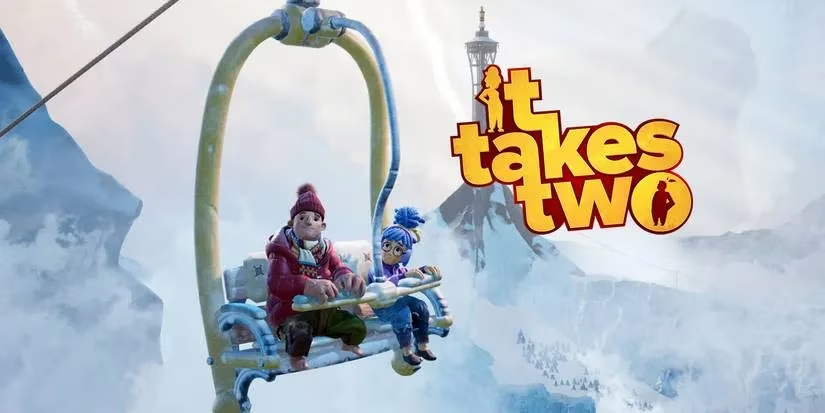
This variety kept the experience from ever growing stale. Hazelight founder Josef Fares had already explored co-op storytelling with A Way Out, but It Takes Two expanded the vision dramatically. The game made a compelling case that two-player mechanics could anchor an entire narrative rather than serve as an optional side mode.
How It Stacked Up Against the Competition
| GOTY 2021 Nominee | Core Experience |
|---|---|
| Deathloop | Stylish single-player loop with optional invasion play |
| Metroid Dread | Solo exploration and isolation |
| Ratchet & Clank: Rift Apart | Single-player dimension-hopping action-platforming |
| Resident Evil Village | Solo survival horror |
| Psychonauts 2 | Narrative platformer focused on one mind at a time |
| It Takes Two | Mandatory two-player co-op built around partnership |
That table alone helps explain why the game stood out. While the other nominees offered excellent solo worlds, only It Takes Two required players to show up with someone else.
A Game for a Locked-Down World
Context matters immensely. It Takes Two launched in March 2021, roughly a year after COVID-19 lockdowns reshaped daily life. Friends and families had turned to multiplayer titles like Among Us and Phasmophobia to stay connected. Even as vaccines began rolling out, the pandemic remained difficult. By early November 2021, the CDC still reported tens of thousands of new weekly cases in the United States, and only about 58 percent of the population was fully vaccinated. Major cities kept emergency mandates in place, and isolation remained a defining part of life.
In that climate, a game fundamentally about rebuilding a relationship felt like more than entertainment. It became a low-stakes way for two people to practice cooperation, communication, and patience—all through a beautifully absurd lens.
Accessibility also played a huge role. It Takes Two supported local couch co-op and online play through EA’s Origin platform. Best of all, only one person needed to own a copy to invite a friend online, echoing the Download Play feature from older Nintendo DS titles. Add the fact that the game joined Xbox Game Pass and benefited from an EA Play bundle, and suddenly the barrier to entry dropped dramatically.
A Different Type of Award Contender
The Game Awards has frequently honored solitary triumphs. God of War, Sekiro: Shadows Die Twice, and The Last of Us Part 2 took home Game of the Year in consecutive years. Animal Crossing: New Horizons earned a well-deserved nomination in 2020 for offering a gentle community during the earliest lockdowns, but it did not win.
It Takes Two represented something slightly different: a cooperative experience that was not a live-service shooter or a party game. It was a crafted narrative with genuine emotional stakes, but one that refused to let players experience it alone. That distinction remains significant in 2026. Hazelight has continued to champion co-op-only design with titles like Split Fiction, but It Takes Two remains the moment the idea broke through on the industry’s biggest awards stage.
Win or lose, It Takes Two deserved its place among the blockbusters. It proved that a game about two people relearning how to listen, compromise, and laugh together could stand on the same stage as the biggest single-player worlds in the industry.
Expert commentary is drawn from OpenCritic, where aggregated critical reception helps contextualize why It Takes Two stood out among its 2021 peers: beyond polished presentation, reviewers consistently emphasized the game’s co-op-only structure as a core artistic choice—tying its constantly shifting mechanics to the emotional arc of repairing a partnership, and reinforcing the blog’s point that “prestige” can be built around collaboration rather than a solitary cinematic journey.